.svg)




For interactive charts, detailed rankings, and the full analysis, please refer to the complete report here.
ICML 2026 accepted 6,341 papers. Counting lead authors, China has the most papers and the U.S. the most spotlights; two countries appear on most of the program, with 66 countries represented in all; industry has an author on about a third of papers; and the largest topic area is language & NLP. We resolved every author's affiliation to a canonical institution and classified every paper by topic to show what the metadata contains.
China leads the most papers. The U.S. leads the most spotlights.
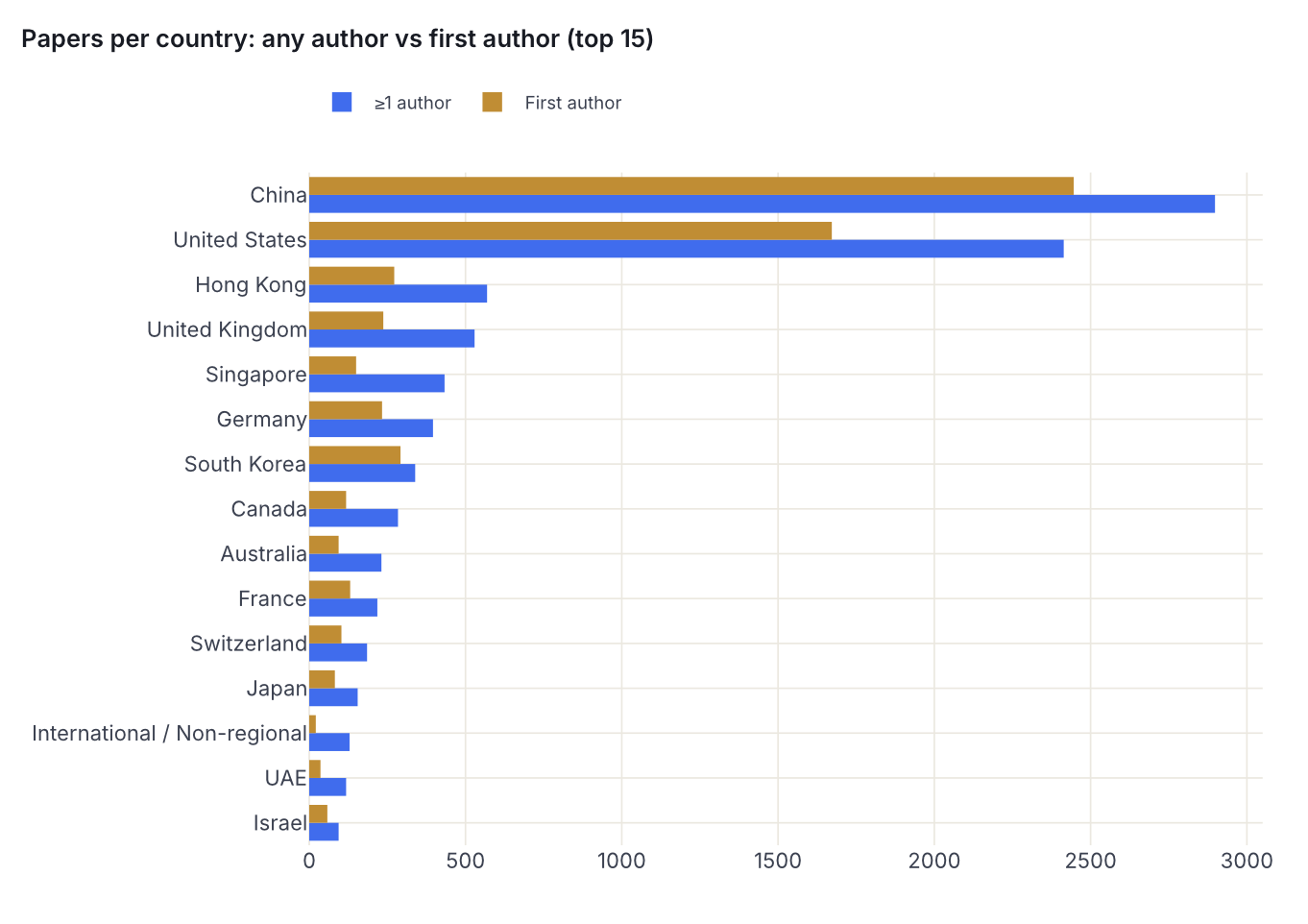
Counting only the first author (the lead author of each paper): China is the first author on 2,446 papers to the U.S.'s 1,675, about 46% more. Among the 536 spotlights, the U.S. is the first author on 172 (32.1%) and China on 154 (28.7%).
A two-superpower conference
Sixty-six countries appear on at least one ICML 2026 paper. China and the U.S. each appear on the largest shares; the U.K., Germany, Switzerland and Singapore lead the remaining countries. 84.4% of China's papers have a Chinese first author, compared with 69.3% for the U.S.

A handful of mega-labs, and many more
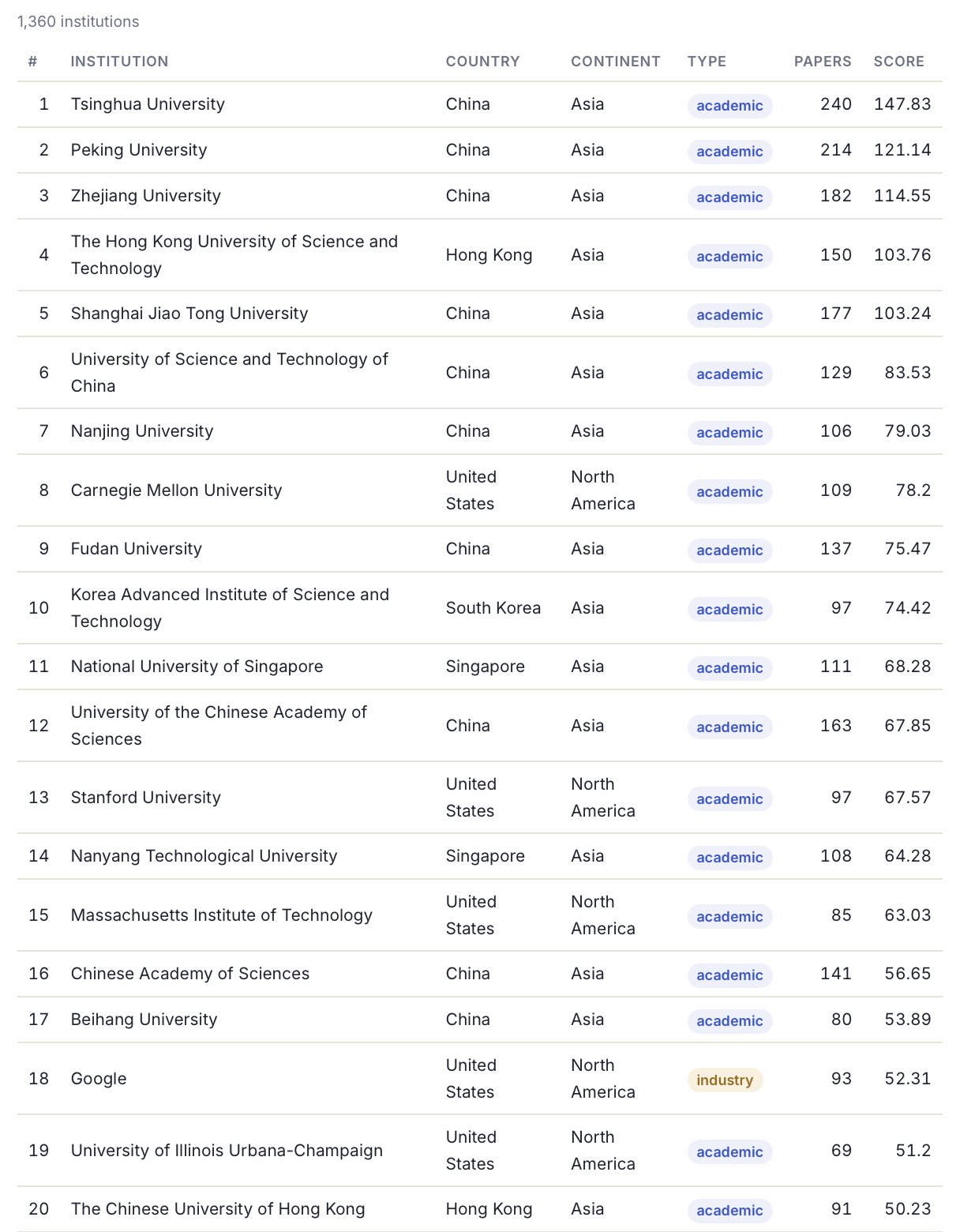
ICML 2026's authors resolve to 1,979 distinct institutions. Tsinghua University has the highest score (147.8, across 240 papers). The full ranking is below; it credits each paper to its first/corresponding-author institutions and is filterable by region.
Industry doesn't dominate the count — but it's concentrated in certain areas
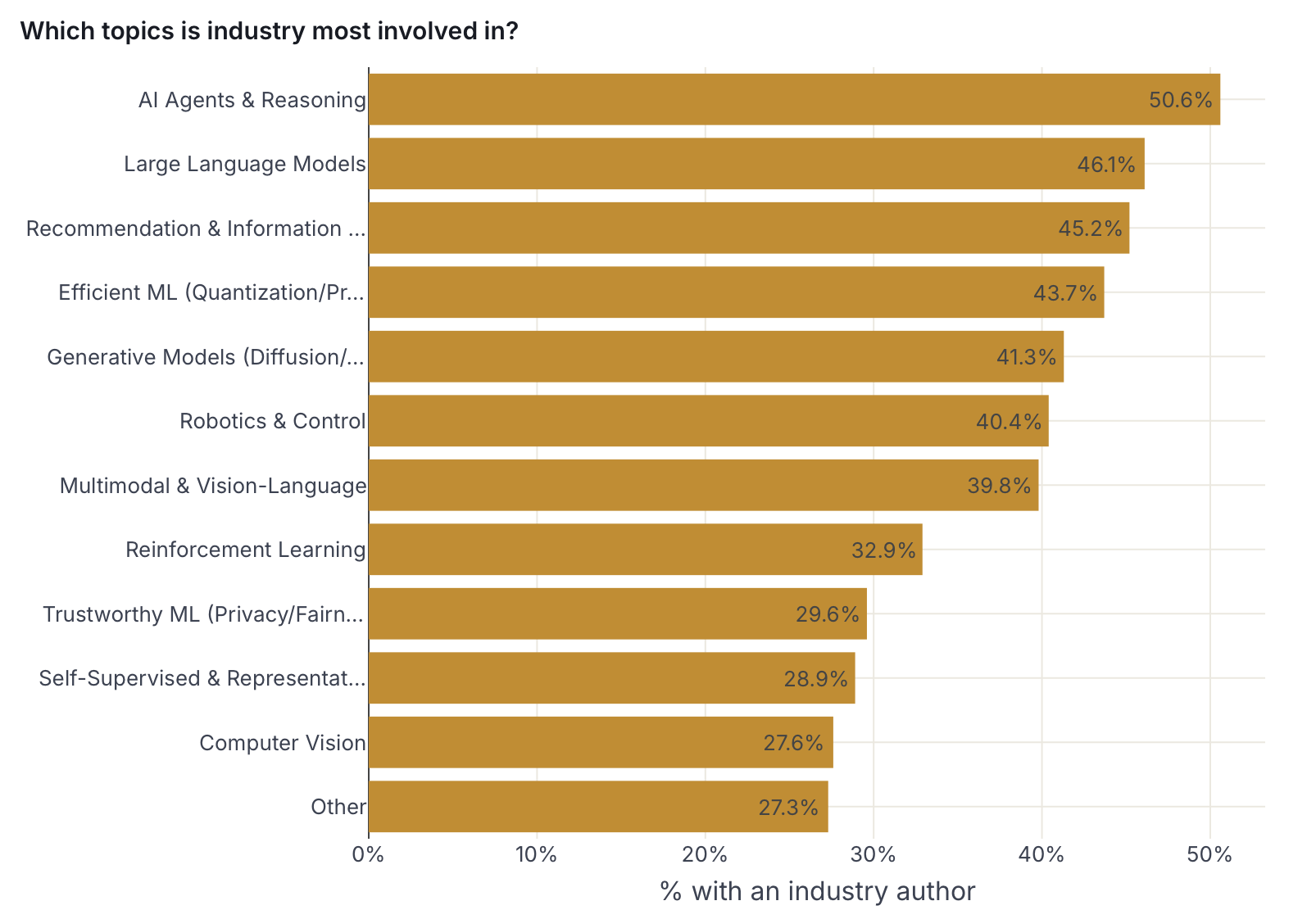
3.2% of papers are purely industry and 65.4% purely academic; 31.2% are academia–industry collaborations, which have the largest average team size (7.3 authors).
The year of the agent
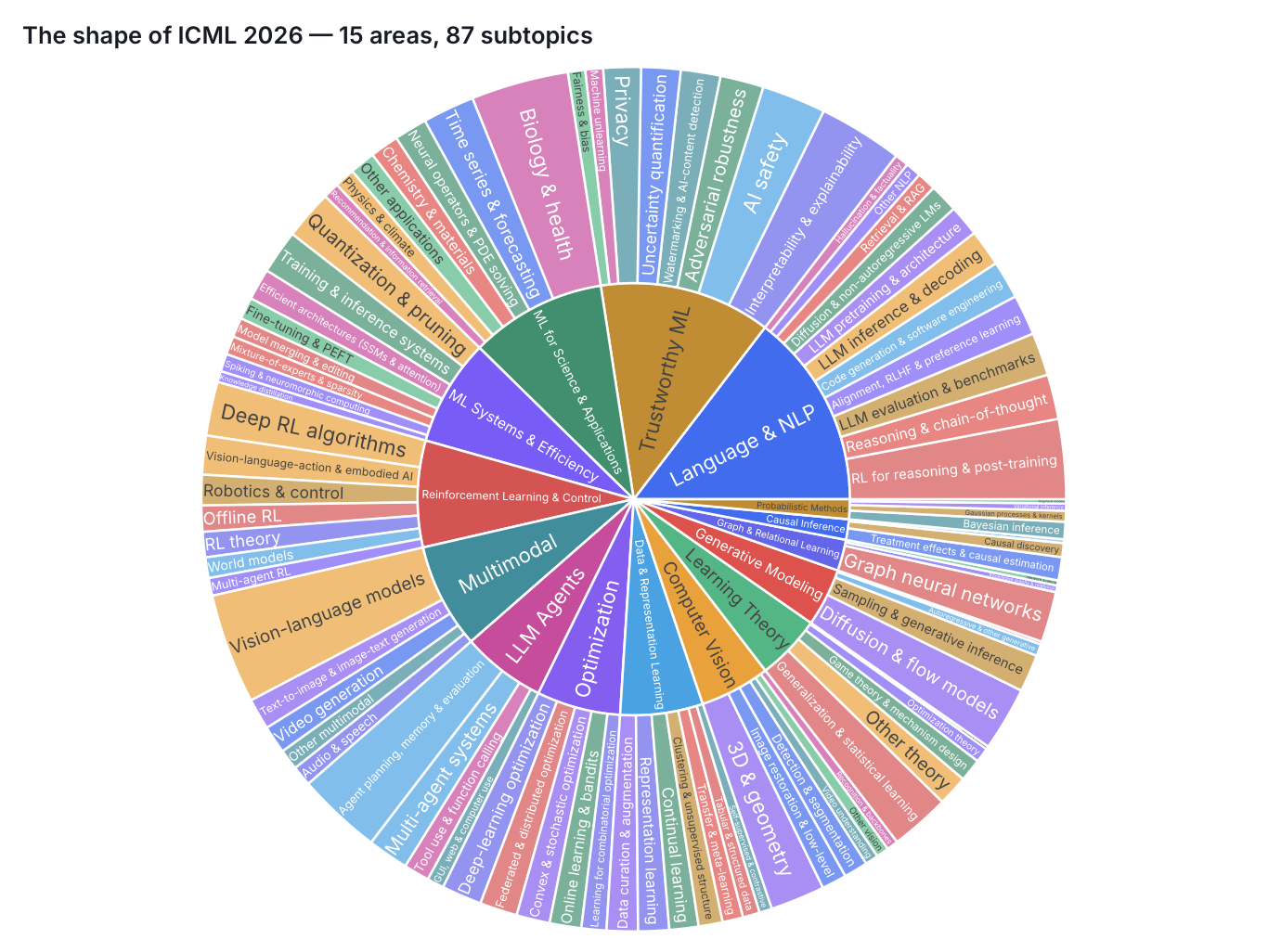
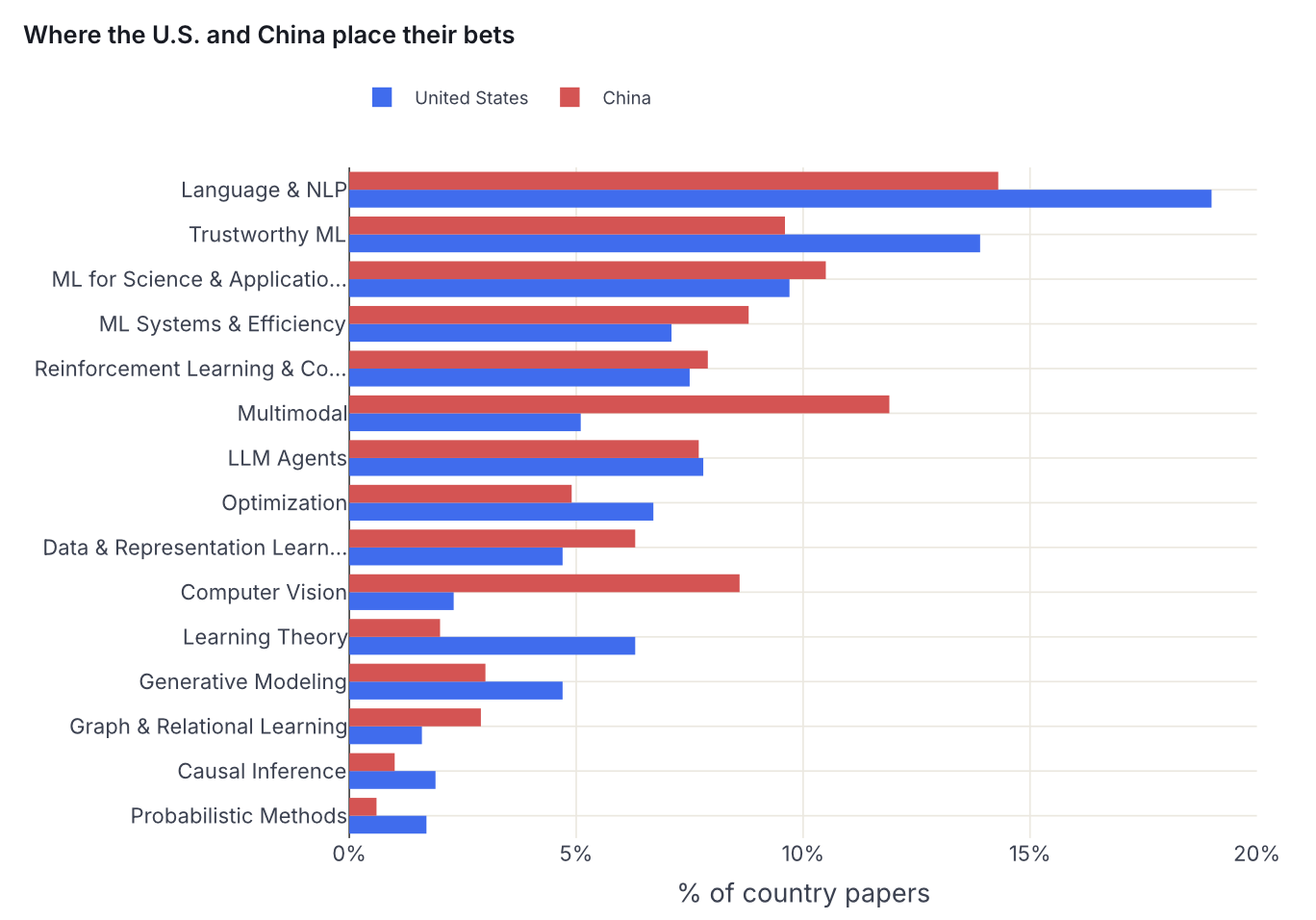
Each paper is assigned to a two-level taxonomy of 15 areas and 87 subtopics. Language & NLP is the largest area at 927 papers (~15% of the conference); its largest subtopic is RL for reasoning & post-training (189). LLM Agents is its own area, with 399 papers. China places 8.6% of its papers in Computer Vision (U.S. 2.3%); the U.S. places 6.3% in Learning Theory (China 2.0%).

Methodology & caveats
1. Author extraction. For all 6,341 accepted papers we read each paper's first page and extracted the author list, affiliations, emails, and the first/corresponding-author flags. Names match OpenReview ~93% of the time.
2. Institution disambiguation. Raw affiliation strings were resolved to canonical institutions — each tagged with a country and an academic/industry label — merging spelling, language, and diacritic variants of the same organization into a single canonical English name. The “country share over time” chart runs the same pipeline on every ICML year back to 2016.
3. Lead authorship & score. “Lead author” = the first author. An institution's score splits a weight of 1 per paper across the distinct first/corresponding-author institutions on it, so no paper is ever counted twice; the leaderboard ranks all institutions with a non-zero score.
4. Topic classification. The taxonomy was not hand-picked. Eight independent LLM agents each read every one of the 6,341 titles and flagged recurring themes with no clean home; consolidating their reports produced a 15-area, 87-subtopic taxonomy — adding areas the field has grown into, such as LLM Agents and Causal Inference. A separate LLM agent then classified every paper from its title and abstract into one area and one subtopic.
5. Two labels per paper. Alongside our label, we keep each paper's author-declared ICML primary area — the area its authors themselves chose at submission — and show both in the explorer. Mapping the two schemes through a fixed crosswalk, our LLM label is compatible with the authors' declared area for ~62% of papers. Agreement is high for well-defined areas (e.g. Causal Inference, Reinforcement Learning) and lower for areas the audit introduced, such as LLM Agents, which the official ICML list doesn't separate out.
Reading the numbers.“NON” is not a country — it's the code for authors with no clear national base (here 129 papers, mostly independent researchers). Participation counting: a paper counts for every country/institution among its authors, so shares sum above 100%. Score splits a weight of 1 per paper across its distinct first/corresponding-author institutions. Spotlight = ICML's top-tier flag (8.5%). Limitations: topics inferred from title+abstract; ~93% name-accuracy vs OpenReview.